
GEOS Insights: The Voltaic Pile
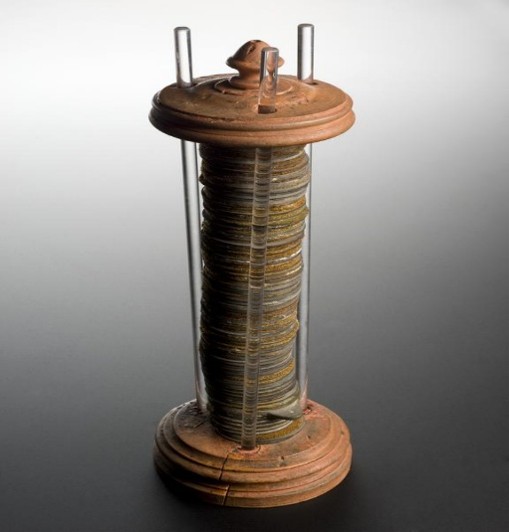
Photo credit: Science Museum Group
June 24, 2026
While battery electric storage systems (BESS) are still in the early stages of adoption, growth is accelerating over 30% per annum in many regions, from the European Union, to SE Asia and in Texas, a large unregulated power market with massive electricity demand and complexity. Installations of utility scale battery storage doubled in Texas last year to 13.9 gigawatts (GW) – enough to power about 16 million homes according to the US Department of Energy. The Electric Reliability Council of Texas (ERCOT) is an independent system operator (ISO) managing the power needs for 27 million customers in the state and over 55,000 miles of transmission lines representing 90% of Texas power load. ERCOT is adopting BESS given peak demand growth which is now greater than forecast even last summer, primarily driven by data center development. Texas is now the largest renewable energy hub in the US, and ERCOT customers are increasingly deploying BESS as a structural hedge to optimize renewable energy, shifting midday solar output to evening peak hours, avoiding stranded power. BESS can also firm electrical capacity to prevent brownouts, as well as provide fast frequency response for critical manufacturing applications such as semiconductor fabrication or data centers.
BESS adoption in Germany has increased as the country phases out coal plants and embraces renewable energy. Current GEOS holding Eos Energy Enterprises (ticker EOSE) offers long-duration BESS using a proprietary zinc chemistry optimized for 4-hour or greater discharge cycles, providing more reliability and resiliency than the legacy 2 hour sytems in the market currently. Last week, Eos announced a 750 megawatt capacity commitment with CAPAC Energy for long duration energy storage across Germany, Austria and Switzerland, with the potential to scale to 2 gigawatts by 2031. The EU is rapldly embracing clean tech solutions given the second war-induced energy shock in five years. Eos just received its first purchase order from Frontier Power USA for a large BESS project in ERCOT named Redbird, with the initial 100 megawatt facility designed to provide dispatchable capacity, enhance grid reliability and support renewable energy integration. This BESS project could scale in phases to over 2 GW, enough to power 400,000 Texas homes under peak summer conditions.
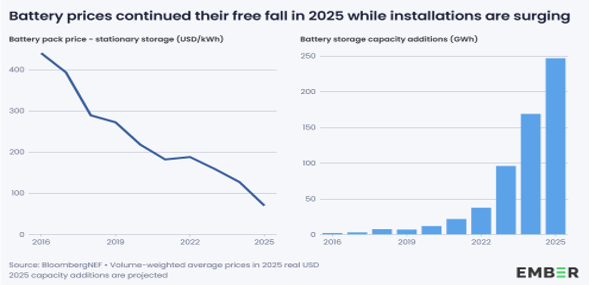
Battery technology has come a long way since the Italian physicist Alessandro Volta invented the first battery, called the Voltaic Pile in 1800. Flash forward to today, and while batteries of all kinds still have the same essential elements, they are now commercially viable for multiple uses, including electrical grid storage. Declining costs have led to massive growth and global adoption as demonstrated by the chart above. We have high conviction in this trend, and have several GEOS battery holdings, from systems installers to technology companies advancing battery safety and performance.
Disclosures
This commentary is for informational purposes only. It does not constitute investment advice and is not intended as an endorsement of any specific investment. The opinions and analyses expressed in this commentary are based on Essex Investment Management LLC’s (“Essex”) research and professional experience and are expressed as of the date of its release. Certain information expressed represents an assessment at a specific point in time and is not intended to be a forecast or guarantee of future results, nor is intended to speak to any future periods. Accordingly, such statements are inherently speculative as they are based on assumptions that may involve known and unknown risks and uncertainties.
This does not constitute an offer to sell or the solicitation of an offer to purchase any security or investment product, nor does it constitute a recommendation to invest in any particular security. An investment in securities is speculative and involves a high degree of risk and could result in the loss of all or a substantial portion of the amount invested. There can be no assurance that the strategy described herein will meet its objectives generally or avoid losses. Essex makes no warranty or representation, expressed or implied; nor does Essex accept any liability, with respect to the information and data set forth herein, and Essex specifically disclaims any duty to update any of the information and data contained in the commentary. This information and data does not constitute legal, tax, account, investment or other professional advice. Essex being registered by the SEC does not imply a certain level of skill or training.
[1] The Wilderhill Clean Energy Index (ticker: ECO) is a modified equal dollar weighted index comprised of publicly traded companies whose businesses stand to benefit from societal transition toward the use of cleaner energy and conservation.
Please find important disclosures here