

Essex Global Environmental Opportunities Strategy (GEOS) – Review and Outlook
Second Quarter ended June 30, 2026
Interest and investment in clean technology gained great momentum in the second quarter of 2026 based on multiple catalysts, all of which we believe will be sustained for years to come. The most recognized trends are increased power demand stemming from data centers, and the need for domestic energy security given the armed conflict in the Middle East. These drivers dominated headlines across the globe, seeding both economic and political discussions. Electricity prices are a major issue for voters as we approach mid-term elections. We describe clean tech as enabling economic growth with less resources, and the drivers go way beyond these headlines. The drivers for clean tech, to which the Essex Global Environmental Opportunities Strategy (GEOS) has broad exposure:
Energy security/independence
Supply chain optimization
Electric grid reliability
Industrial productivity
Energy efficiency
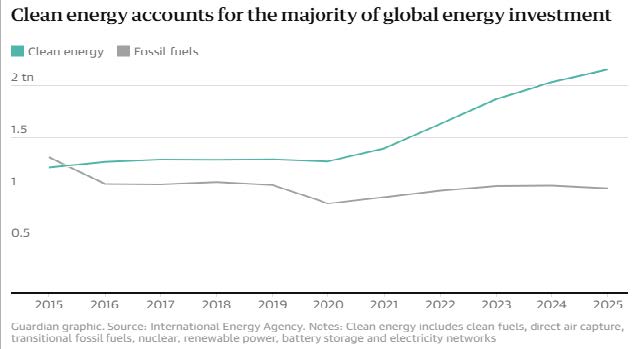
As our world faces enhanced geopolitical and economic risks, from nationalism to a stubborn inflationary cycle, the companies addressing these five drivers will enable economic growth while lowering costs and enhancing productivity – the very essence of clean technology solutions. One example is the chart below, exhibiting increased investment in clean energy versus fossil fuels. Just as the drivers for clean tech have increased and deepened, the solutions are more commercially viable today, with decreased costs that are driving adoption, from advanced battery solutions to industrial automation.
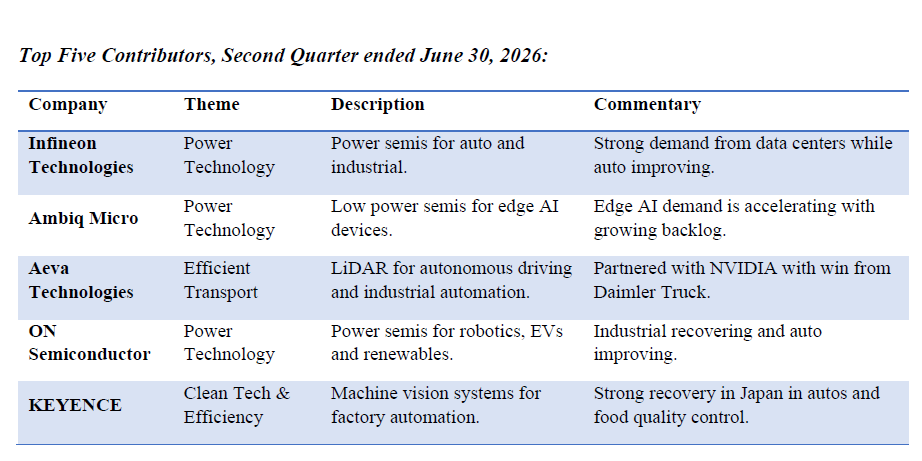
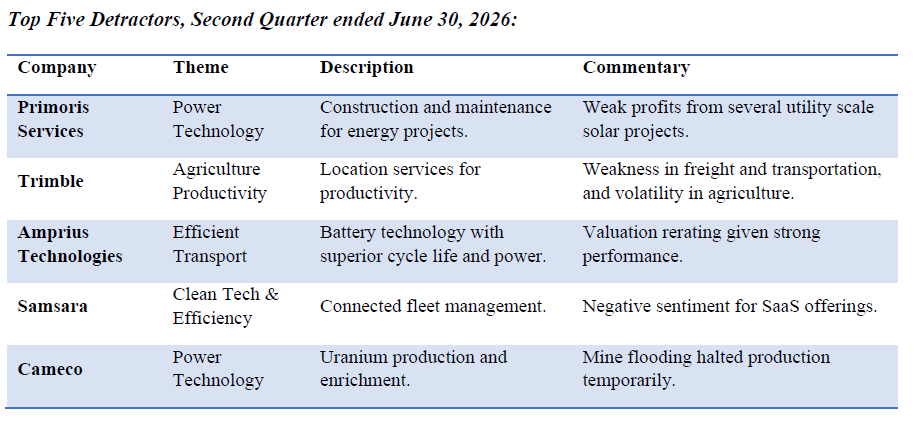
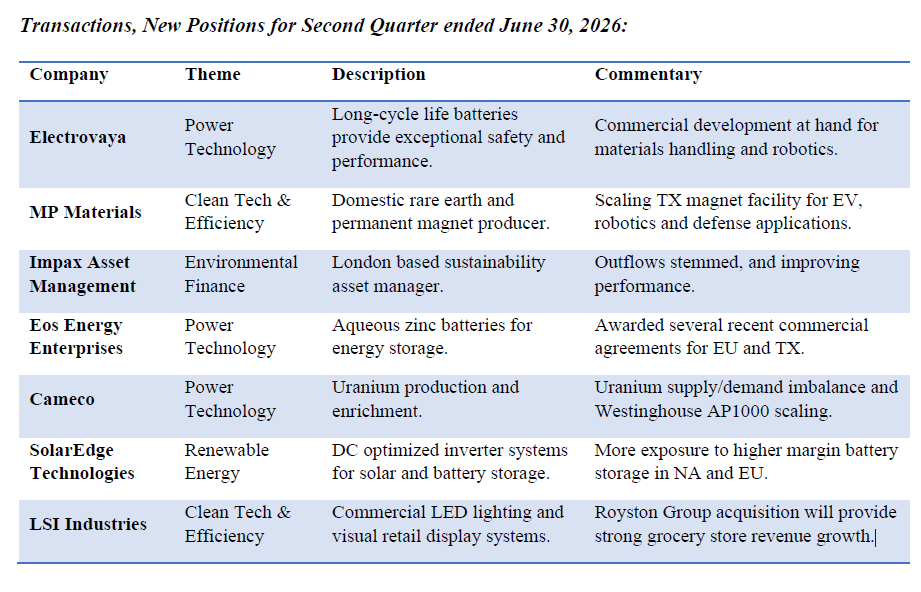
We took advantage of recent market volatility by taking profits in holdings with significant price appreciation, while adding to positions which have lagged in the portfolio. Profit taking was executed with machine vision systems firm Cognex, irrigation company Valmont Industries, and low power semiconductor firm Ambiq Micro. Power semiconductor holding Infineon Technologies was trimmed after strong performance and to lessen portfolio risk. Enphase was also trimmed after rapid price appreciation early in quarter, as a source of funds for SolarEdge, which operates in adjacent markets. We added to holdings weights in the following stocks, based on lagging portfolio performance and our long-term conviction regarding their fundamentals:
Alfen: Based in the Netherlands, providing transformer and energy storage solutions.
Badger Meter: Water management systems for utilities.
Lindsay: Highly efficient agricultural irrigation.
Samsara: GPS fleet monitoring services.
Solv Energy: Leading US utility scale solar developer and manager.
SMA Solar Technology: Leading European solar power inverter firm.
Outlook
Our five drivers most relevant to clean technology solutions are:
Energy security/independence
Supply chain optimization
Electric grid reliability
Industrial productivity
Energy efficiency
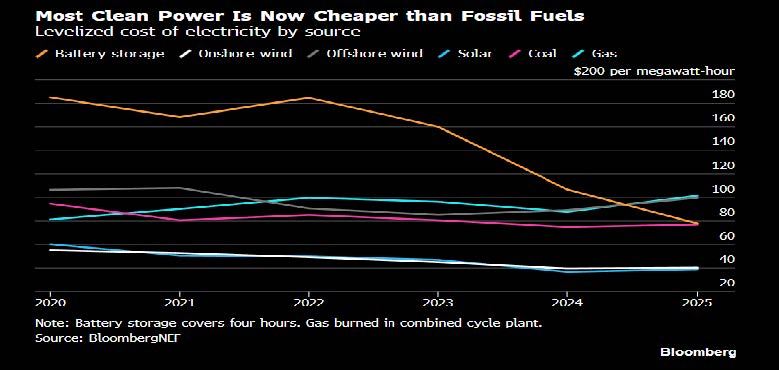
The massive spike in power demand has strained old systems, and these drivers represent the shift away from simply building more power plants towards the optimization of the entire energy ecosystem. You cannot have grid reliability and energy security without focusing heavily on efficiency and industrial productivity. The five drivers maximize the output our systems have presently, as industrial productivity and supply chain optimization can reduce waste and resources, as energy efficiency and grid reliability ensure that power generated is utilized optimally without being lost to transmission bottlenecks or outdated infrastructure. These five drivers are solving the real-world pain points, grounding solutions in hard economic and geopolitical realities. By optimizing supply chains or enhancing energy security, clean tech reduces vulnerability to geopolitical fragmentation and volatile global commodity markets. Through enhancing industrial productivity and our electrical grid, the physical backbone of our economy is upgraded so it can run uninterrupted. These five drivers are the thematic blueprint to power and secure a highly productive and low-resource intensive future. Importantly, we have made progress in pockets of these drivers globally the past decade, but not wholly. For example, solar power is mature, and now cheaper than any fossil fuel power source:
Battery electric storage systems (BESS) are extremely beneficial in this new energy ecosystem, although we are in very early innings – think of solar power over a decade ago. Battery costs have decreased over 90% in the past several years, based on learning curves not exhibited with fossil fuels such as natural gas:
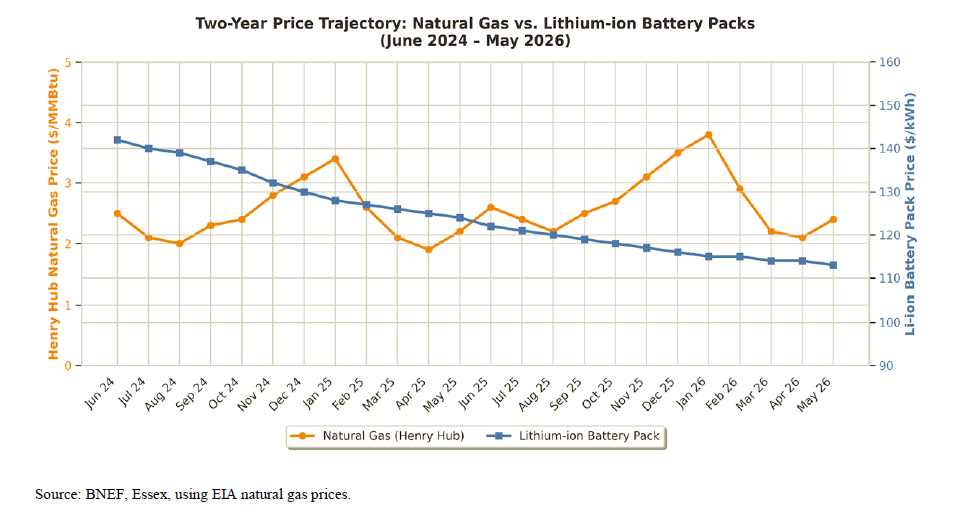
The fundamental difference between clean technologies such as BESS and fossil fuels is the difference between technology and a commodity. BESS is manufactured, and the steep learning curves are disrupting fossil fuels based on extraction economics, meaning their prices are highly volatile and do not permanently decline. It is for this reason that BESS installation rates are highest now in the EU, which has been burned twice with two successive wars in several years. Overnight, the EU has implemented energy security measures, from solar and storage installation goals to energy efficiency initiatives. Texas is also rapidly installing BESS, given the rapid data center development coupled with volatile real-time electricity pricing in the throes of severe weather. GEOS has extensive exposure to these five drivers, from battery technology to grid optimization and management, to building energy efficiency. We believe that the case for clean technology is grave currently, just as these technologies are maturing. Importantly, the market is taking notice, but there are many different and related avenues of opportunity that still go unnoticed by the broad market which we believe will be equally recognized over time.
Disclosures
This commentary is for informational purposes only. It does not constitute investment advice and is not intended as an endorsement of any specific investment. The opinions and analyses expressed in this commentary are based on Essex Investment Management LLC’s (“Essex”) research and professional
experience and are expressed as of the date of its release. Certain information expressed represents an assessment at a specific point in time and is not intended to be a forecast or guarantee of future results, nor is intended to speak to any future periods. Accordingly, such statements are inherently speculative as they are based on assumptions that may involve known and unknown risks and uncertainties.
This does not constitute an offer to sell or the solicitation of an offer to purchase any security or investment product, nor does it constitute a recommendation to invest in any particular security. An investment in securities is speculative and involves a high degree of risk and could result in the loss of all or a substantial portion of the amount invested. There can be no assurance that the strategy described herein will meet its objectives generally or avoid losses. Essex makes no warranty or representation, expressed or implied; nor does Essex accept any liability, with respect to the information and data set forth herein, and Essex specifically disclaims any duty to update any of the information and data contained in the commentary. This information and data does not constitute legal, tax, account, investment or other professional advice. Essex being registered by the SEC does not imply a certain level of skill or training.
Please find important disclosures here