

Essex Global Environmental Opportunities Strategy (GEOS) – Review and Outlook
Third Quarter ended September 30, 2026
Clean technology equities were off to the races this year until late July, when the market sold off given significant and sudden interest rate pressures driven by spiking ten-year treasury yields. Higher interest rates have a greater impact on some clean tech segments, as the higher cost of debt lowers returns for project finance – the dominant funding structure for wind, solar and battery storage, as rising rates increase interest burdens on construction loans. We believe the market was overly aggressive in selling down clean tech more severely than other equity sectors, creating very favorable opportunities. Clean tech is positioned as the economy’s structural deflationary force, at the intersection of artificial intelligence (AI), energy security and discounted valuations. We believe over the past several years, clean tech has graduated from a policy-dependent, rate-sensitive growth trade into a structural infrastructure and productivity improvement theme. We believe for profitable, cash-generative clean tech companies, the investment case now rests on demand that is AI-driven, geopolitically reinforced, economically deflationary, and priced at a significant discount to historical valuation metrics.
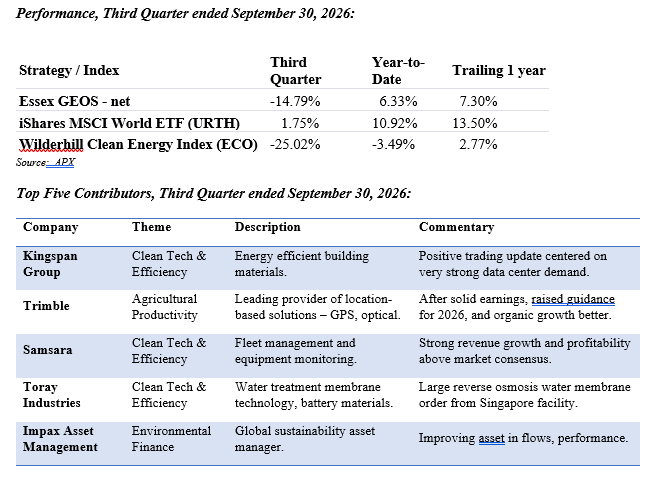
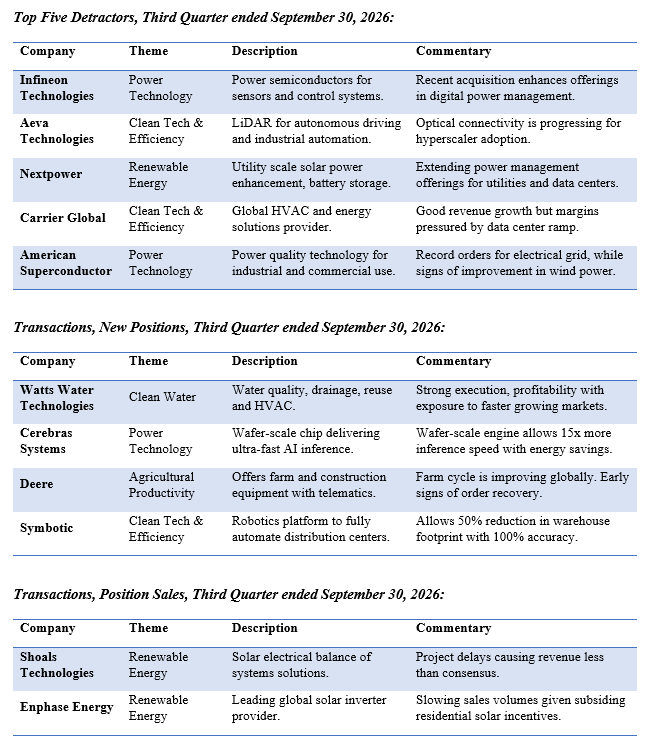
We believe the correction which began in late July was concentrated amidst companies the market assumed were tied to data centers and AI, and portfolio volatility was also concentrated in a few higher beta holdings. While data center exposure does factor as a growth catalyst for some holdings, it is not the primary factor – the general demand for power and increased electrification of the overall economy is the prevalent driver. That said, we de-risked the portfolio by cutting some weight in the Power Technology theme and beta by trimming American Superconductor, ON Semiconductor, Aeva Technologies, Ambiq Micro, and Infineon Technologies. We are confident in our investment rationale for these companies and will continue to reevaluate portfolio weights as market conditions warrant. Holding share positions where weights were reduced is an active decision, and one which we believe illustrates our portfolio risk management enhancements of the past several years. Each of these positions were contributors to return over past quarters, and our confidence for the Power Technology theme is well intact.
The GEOS Clean Water theme has generally been a performance detractor for the past several quarters, but performance for water companies exposed to the industrial segment is beginning to improve. We have owned Veralto since early 2025 and added to the position as margins and revenue improve driven by industrial water treatment. Solar Edge was added to GEOS last June, and we increased the weight during the quarter given strong sales improvement, particularly in Germany. The EU is a net energy importer and is under extreme duress from the limited fossil fuel imports given Hormuz and is taking strong action to strive for energy independence via renewables and energy efficiency. We increased the Portfolio weight in Solv Energy, the solar and storage developer, given the compelling valuation amidst strong fundamentals regarding domestic power demand.
Outlook
The are four key drivers for clean tech now:
1 – AI and electrification are creating structural, policy-independent demand. The demand driver for clean tech has fundamentally shifted from policy subsidy to economic necessity. The constraint is now power supply, not demand. We believe after reviewing multiple projections that data centers should double their share of US electricity demand to 20% by 2030, and the hyperscalers are driving long term power purchase agreements (PPAs) which are focused on solar and storage. These demand drivers are structural, not cyclical, and will be a significant catalyst for renewable energy adoption, potentially exceeding the impact of the Inflation Reduction Act (IRA) despite its rollback. Solar and storage have been gaining the cast majority of net new power capacity because it is best positioned from cost and dispatchability. Texas is a great example, which recently took over the renewables pole position from California, given stronger State power demand from data centers and general industry:
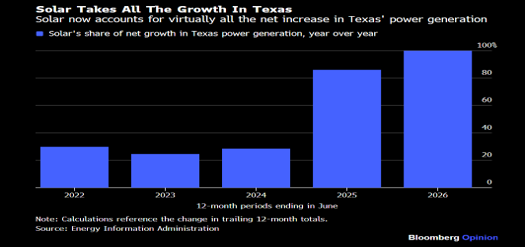
Battery storage is equally important in Texas, and ERCOT has doubled stationary battery storage in the past 18 months, optimizing solar power generation amidst grid stress with congestion and severe weather. Notably, as the chart below depicts, while power demand is increasing at the greatest rate in 20 years, and data centers equate to a large percent of current growth, there is a step up in demand across the economy, and this creates significant growth opportunities for our Power Technology theme.
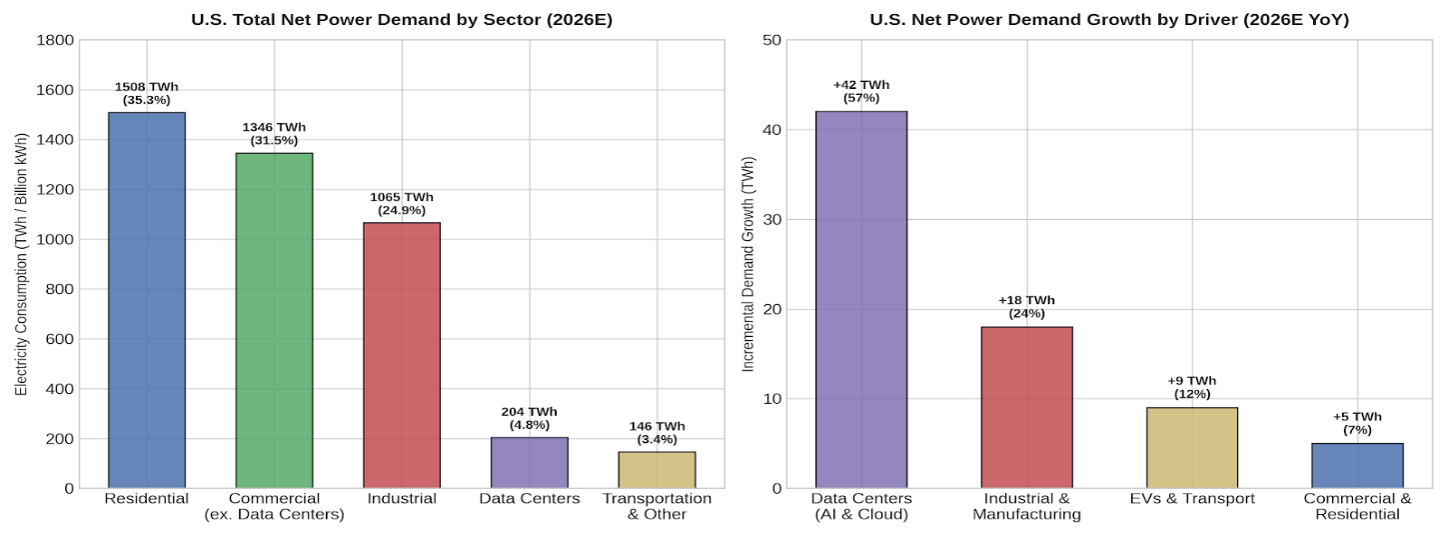
Source: IEA, EIA, Gartner.
2 – Clean tech is now critical infrastructure due to energy security. The 2026 Strait of Hormuz crisis has permanently elevated the energy security premium, reframing clean domestic energy supply chains as critical national infrastructure rather than pure sustainability policy. Renewables are now positioned as energy security assets, not purely environmental investments, particularly in Europe and other fossil-fuel import dependent markets where natural gas price volatility has quickly strengthened support for domestic renewable generation and energy efficiency programs. Elevated energy prices are strengthening the case for clean electrification and grid infrastructure investment, leading to a rapid pivot to renewable energy and grid development and investment:
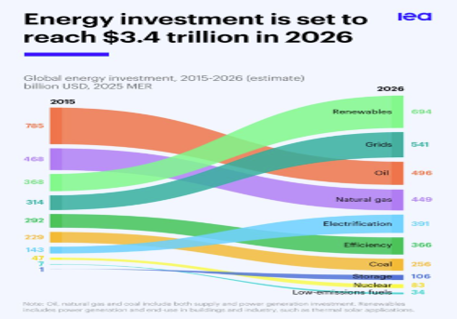
3 – Clean tech is a deflationary force for the broader economy. Clean tech, from behind the meter energy storage to industrial automation converts variable, inflation exposed input costs into fixed, depreciating capital assets. Clean tech enhances productivity while lowering inflationary risk:
-solar power has fallen in price over 80% the past decade, making it the cheapest source of new energy in most parts of the world (source: BNEF).
-EV owners save approximately $1,500 per year in fuel costs versus gas vehicles (source: BNEF).
-industrial automation, such as robotics, machine vision, or warehouse systems can reduce cost per case processed up to 80% enhancing business productivity (source: TD Cowen).
The supply side productivity story of clean tech is an important nuance, as the market tends to price it on rate sensitivity, not on deflationary benefits. GEOS invests in companies enhancing the electrical grid, automating warehouses, or optimizing goods delivery. These technologies and services generate long-term efficiency gains that expand productive capacity – the very definition of non-inflationary growth.
Renewable energy PPAs are long-term contracts and fixed price, locking in the cost of electricity, and insulating the offtaker from future power price volatility, regardless of where interest rates or commodity prices move. This is particularly valuable for energy-intensive companies managing input cost risk. Amidst energy inflation, the cost declines of solar and storage of up to 86% are displacing fossil fuels whose prices are volatile and structurally tied to geopolitical supply dynamics. Renewables and clean tech broadly reduce energy input costs which is inherently disinflationary. It is the oil price spikes which have been the primary transmission mechanism for broad inflation, and clean energy and technology provides insulation from commodity price shocks. The chart below provides strong depiction of these important catalysts comparing 10-year treasury yields to oil and battery prices:
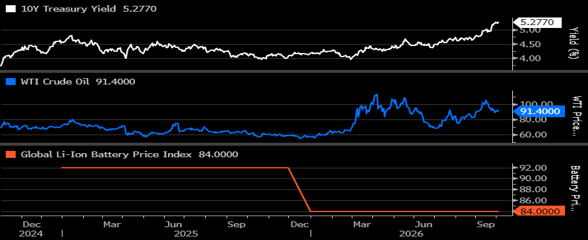
Source: BNEF battery price, Bloomberg.
4- Profitable clean tech is deeply undervalued relative to its history. The market by our analysis is pricing profitable clean tech companies at a 42% discount to their own five-year historical multiples, despite the strongest earnings growth outlook in the sector’s history. According to BNEF and Barclays, clean tech funding has increased 73% over the past year, yet capital allocation data confirms the market is functioning as a quality filter, as non-profitable company participation in equity offerings fell 76%, while profitable companies maintained access, concentrating capital in companies with demonstrated earnings power. Current observations after the third quarter show the clean tech laggards are being cut off from capital, and this is exhibited in their share price performance. This is important, as the demand curve for clean tech has never been better, as most segments of clean tech have matured, and demonstrate historically high profitability. Profitable clean tech is in a structurally stronger position than at any point in the past decade, with accelerating earnings growth, improving margins, and valuations that sit at a meaningful discount to historical averages:
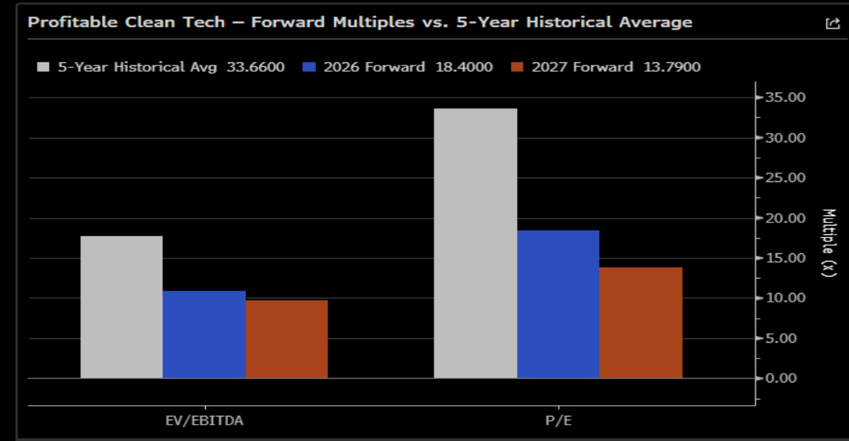
Source: BNEF Renewable Energy universe of 318 companies, consensus forward estimates, Essex analysis.
The core thesis for profitable clean tech into 2027 is straightforward: earnings are growing at double-digit rates, the demand drivers are structural rather than policy-dependent, and the market is pricing the sector at a 42% discount to historical multiples. Clean tech has graduated from a rate-sensitive trade into a structural infrastructure and productivity story, which is power supply driven, geopolitically reinforced, economically deflationary and priced at a significant discount to history.
Disclosures
This commentary is for informational purposes only. It does not constitute investment advice and is not intended as an endorsement of any specific investment. The opinions and analyses expressed in this commentary are based on Essex Investment Management LLC’s (“Essex”) research and professional experience and are expressed as of the date of its release. Certain information expressed represents an assessment at a specific point in time and is not intended to be a forecast or guarantee of future results, nor is intended to speak to any future periods. Accordingly, such statements are inherently speculative as they are based on assumptions that may involve known and unknown risks and uncertainties.
This does not constitute an offer to sell or the solicitation of an offer to purchase any security or investment product, nor does it constitute a recommendation to invest in any particular security. An investment in securities is speculative and involves a high degree of risk and could result in the loss of all or a substantial portion of the amount invested. There can be no assurance that the strategy described herein will meet its objectives generally or avoid losses. Essex makes no warranty or representation, expressed or implied; nor does Essex accept any liability, with respect to the information and data set forth herein, and Essex specifically disclaims any duty to update any of the information and data contained in the commentary. This information and data does not constitute legal, tax, account, investment or other professional advice. Essex being registered by the SEC does not imply a certain level of skill or training.
Please find important disclosures here